Your employees bring personal challenges to work: unreliable transportation, a housing crisis, a parent who needs care. You want to help, partly because you care about the person and partly because you need your team at 100%. Wanting to help has never been the hard part.
Now North Shore employers are banding together to put some professional heft behind that intention. We're sharing the cost of one full-time Success Coach, employed by Wellspring House, who spends half a day each week on site at each member company, meets confidentially with employees, and does the legwork to get their problems actually resolved. It's called an Employer Resource Network. Employers elsewhere have been running the model for close to twenty years, and it's new to Massachusetts.
Deposits are fully refundable if we don't reach 5, and convert to your first payment if we do. Not ready for either? Read on.

Your HR team is fielding personal crises they were never staffed or trained to handle, in between payroll and benefits enrollment. The Coach takes those conversations.
The Coach makes the call, books the appointment, follows up the next week, and keeps going until the thing is resolved. A trusted person your employees can find in the building.
Employees talk to someone outside their chain of command, which is why they talk at all. You never come into possession of information you'd rather not hold.
None of us could justify this hire alone. Eight of us splitting it puts a dedicated, experienced person in every member's building, employed and supervised by Wellspring House.
Gloucester and Salem, MA Seven North Shore operators dealing with the same labor market, commute patterns, and agencies. Members of established networks consistently report the peer relationships as an unanticipated benefit.
Aggregate, de-identified reporting on what your workforce is running into and how often. Most of us are guessing at this. You'd be measuring it.
A father who can't be left on his own. A dispute with a landlord. A childcare center that closed with two weeks' notice.
When people you rely on aren't fully present, your business feels it and so do your customers. You've tried to help. But between a business to run, privacy laws to respect, and the fact that none of us has a degree in social work, it's hard to know whether what you did accomplished anything. Sometimes it doesn't, and a few months later you're posting the job and onboarding somebody new.
That's the gap. It's fixable, and it's simply too expensive for any one of us to fix alone.
So we're sharing it. North Shore employers are jointly hiring a full-time Success Coach who will spend half a day each week at each of our workplaces. It's new to Massachusetts. It's been running for close to twenty years elsewhere, with results that have been independently studied.
There are 26 ERNs operating across the United States and none yet in Massachusetts. This is one of the established Michigan networks, and it's the clearest look we've found at how the model works day to day. Ours will operate the same way, on the North Shore, with Wellspring House running it.
The Success Coach is a full-time professional employed by Wellspring House and shared across all eight member companies. They spend half a day each week on site at your workplace, so your employees can find them without making a phone call or filling anything out.
Front-line employees will use it most, and the Coach is available to every employee at a member company regardless of role or pay grade. A supervisor trying to arrange care for a parent has the same claim on the Coach's time as anyone else.
Most employers we talk to assume they've got this covered. Worth comparing directly:
That last row is the argument. A benefit nobody uses returns nothing, however good it looks in the handbook.
Sources: U. of Michigan Poverty Solutions, 2020; ERN USA reports 15.3% average utilization in its 2025 KPI report.The Coach is employed and supervised by Wellspring House. What your employees tell them stays with them. You'll get aggregate, de-identified reporting on how much the service is being used and what kinds of problems are coming up, and you won't get names. That's deliberate, and it's the reason people use it.
The Employer Resource Network model started in West Michigan, out of a manufacturer's work with state social services on recruiting and keeping people who faced barriers to steady employment. It's been replicated carefully since then, and studied by people with no stake in the outcome.
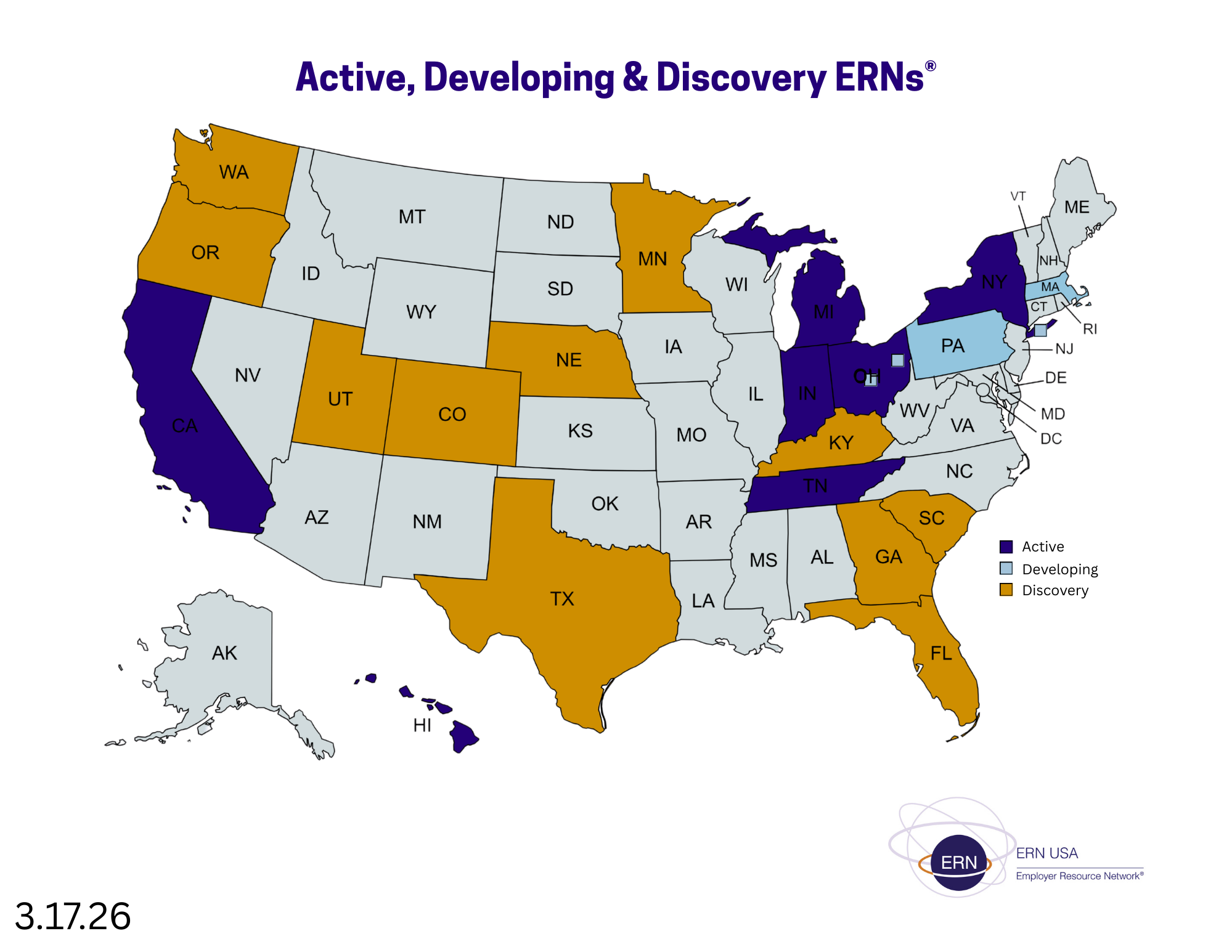
Today the model is active in seven states, developing in two, and in discovery in eleven more. Massachusetts is one of the two developing, and that's us.
ERN USA also reports that member businesses average a 500% return on investment once a network is past its startup period, mostly through reduced turnover and lower recruiting and training costs.
Last year the average ERN USA member employer had 32 employees get real help and 63 problems solved — transport, childcare, housing, debt.
Those are the things that make good people miss shifts, and then quit.
A $1,000 deposit holds your place, and you get it back in full if we don't launch.
If you'd rather hear this from an employer already sitting in an ERN somewhere else before you put money down, say the word and we'll set up the call.
No foundation convened us. No agency proposed it. A few of us on the North Shore were dealing with the same retention problem, worked out that none of us could afford to solve it on our own, and went looking for someone who could run it properly if we pooled the cost.
Wash Cycle Laundry did the looking and found Wellspring House. The network is funded by its members, governed by its members, and answerable to them, and that holds as it grows.
Think of it the way you'd think about any shared vendor arrangement. We pooled our purchasing power, we chose the vendor, we pay the bills, and we hold them to the work.
Wellspring House has been doing workforce development on the North Shore out of Gloucester for decades. They know the employers here, they know the agencies, and they know the communities our people come from, including the immigrant communities that make up so much of the regional workforce. They've been in those relationships for years, which is exactly what makes a referral network function rather than exist on paper.
They'll employ and supervise the Coach, maintain the referral network the Coach draws on, and run the network's administration.
We picked them on purpose and we'd pick them again. A consortium like this is only as good as the organization operating it, and we're confident in ours.
We're registered with ERN USA as an ERN in Formation. They maintain the model, provide technical assistance to networks getting off the ground, and connect us to the 26 networks already operating. We're implementing something with a track record, with help from the people who built it.
5 shares launches the network. We've already secured philanthropic funding to cover the gap between 5 and 8, so the Coach gets recruited, hired and trained and your people start getting help while the last shares close. That money is committed and doesn't depend on any further fundraising.
The Coach's schedule is built around your shift pattern, not the other way around. On-site hours can rotate across shifts and days of the week so the same people aren't always the ones who can't reach it. If your headcount or shift spread means one visit a week genuinely isn't enough, you can purchase more than one share and get proportionally more of the Coach's time.
A private space where the Coach and an employee can meet. Beyond that, ERN USA has handled rollout for dozens of employers and will work with you on a launch plan built for your workplace, covering how the service gets announced, where it sits in onboarding, and how much paid time you want to allow for meetings. You decide those, with people who have done it before.
The initial commitment is one year, with no obligation to renew. Your cost does not rise to cover an empty seat. Through the startup phase, philanthropic capital fills any gap left by unsold or vacated shares, which is the same funding that lets the network launch at five rather than waiting for eight.
Success Coaches work to clear guidelines about which categories of information get reported up to management, and ERN USA has years of experience applying them across dozens of workplaces. Schedule a call and we'll walk through the playbook for safety issues, harassment complaints, and wage concerns in detail.
Something here we haven't answered? Bring it to a call.
Schedule a call2 shares are committed. We launch at 5. The network becomes self-sustaining at 8.
A $1,000 deposit holds your place, and you get it back in full if we don't launch.
Deposits are held by Wellspring House until the network launches.
Taking you to the calendar now so you can book your intro call.
Book your intro callNot redirected? Use the button above.
Book a call and we'll walk you through it, no obligation. We're also happy to put you in touch with an employer already running this in another state.
Schedule a call with the organizersDeposits are held by Wellspring House until the network launches. Binding terms will be a short signed agreement linked from this page.